 Clarity Payment Hub™ / Feature
Accounts Receivable Software for Manufacturers: Faster AR, Integrated to the ERP
The right accounts receivable software turns a back-office cost center into a self-service portal that customers actually use. Manufacturing AR has a specific shape: Long order-to-cash cycles, dealer and distributor billing across multiple locations, project-staged invoices, and ERP environments (NetSuite, SAP S/4HANA, Microsoft Dynamics 365, Plex, Epicor Kinetic, Infor SyteLine, DELMIAWorks) that handle data differently from generic mid-market ERPs. AR automation software built for manufacturing has to fit those constraints, post cash to the ERP deterministically and protect cash flow timing, and let dealers pay multiple invoices at once without phoning the AR team.
-
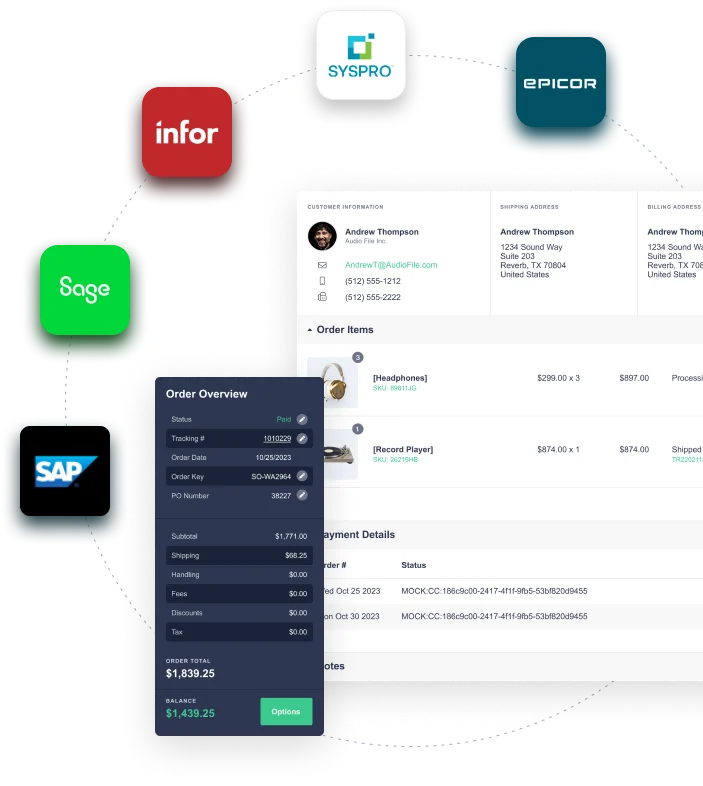
Accounts receivable software integrates with manufacturing ERPs (NetSuite, SAP, Dynamics 365, Plex, Epicor, Infor, DELMIAWorks) and posts cash to the ERP in real time, with no manual data entry.
-
Accounts receivable automation software addresses manufacturing-specific patterns. Modern accounts receivable automation software handles dealer/distributor self-service, partial-payment splits on large project invoices, multi-plant rollups, and consolidated invoicing across dozens of monthly orders.
-
AI powered payment reminders and automated invoicing keep payment tracking accurate and accelerate cash flow without adding headcount to AR process operators.
-
Mid-market manufacturing and mid sized businesses deployments improve the accounts receivable process and typically go live within two to four weeks of receiving ERP sandbox credentials.
-
Pricing models are simple: SaaS at $599 per month or one-time license at $15,000, with manufacturing ERP connectors included.
The right accounts receivable software turns a back-office cost center into a self-service portal that customers actually use. Manufacturing AR has a specific shape: Long order-to-cash cycles, dealer and distributor billing across multiple locations, project-staged invoices, and ERP environments (NetSuite, SAP S/4HANA, Microsoft Dynamics 365, Plex, Epicor Kinetic, Infor SyteLine, DELMIAWorks) that handle data differently from generic mid-market ERPs. AR automation software built for manufacturing has to fit those constraints, post cash to the ERP deterministically and protect cash flow timing, and let dealers pay multiple invoices at once without phoning the AR team.
What Manufacturer AR Software Does
Accounts receivable software is a self-service customer portal plus an integration layer to the seller's ERP. The portal lets dealers, distributors, and direct buyers view open invoices, pay one invoice or multiple invoices in a consolidated transaction, set up automated reminders, and track payments. The integration layer writes every payment back to the ERP as a multi-line cash receipt with the right allocation against each invoice. Finance teams stop doing accounts receivable manual data entry, additional manual data entry on adjustments, and manual effort on inbound payments and start watching exceptions instead.
For a manufacturer running monthly net-terms billing, the typical buyer holds five to twenty open invoices at any time. Generic AR software and SaaS-style AR software designed for SaaS billing data entry handles single-invoice settlement well but breaks on the patterns manufacturers actually run: A dealer paying for the month's part orders in one wire, a distributor splitting payment across three invoices to align with the buyer's pay cycle, a contract manufacturer consolidating milestone invoices at project close. Accounts receivable automation software built for manufacturing handles these patterns natively without making the AR team rebuild the cash receipts by hand each month.
AR Automation Software vs the ERP-Native AR Module
Most manufacturing ERPs ship with a basic AR module rather than full accounts receivable AR automation. The module generates invoices and tracks open balances. What it usually lacks is a customer-facing portal that handles the full invoicing and payment processing: Dealer self-service login, multi-invoice payment selection, AI powered automated reminders, deterministic posting across multiple payment methods, and dashboard reporting that finance teams can act on. Bolting accounts receivable automation software onto the ERP fills the gap without ripping out the existing systems that run production.

The AR Problem in Manufacturing: Manual AR Processes That Tax Finance Teams
Manufacturing accounts receivable automation is harder than most B2B AR because the buyer base is heterogeneous. A single manufacturer might invoice national-account distributors on EDI, mid-market dealers through a portal, and direct enterprise customers via emailed PDFs. Each channel routes back through the same ERP, but each generates different exception patterns that the AR team has to clear by hand. Without accounts receivable automation and AR automation, finance teams spend the bulk of the week chasing payments, fixing misallocated cash, and rebuilding tracking payments reports and the accounts receivable process from scratch each month.
Where Manual AR Tasks Show up in the Invoice to Cash Process
The cost of manual AR work shows up at three points in the invoice to cash process. First, generating invoices and invoice generation: When a customer asks for a custom-formatted invoice or a specific line-item breakdown, generating invoices manually consumes 15-30 minutes per ask. Second, allocation of received cash: When a dealer wires a lump sum that covers eight invoices, the AR person has to allocate the cash by hand against each open invoice. Third, incoming payments: When a customer asks why an outstanding invoice still shows open after a wire cleared two weeks ago, someone has to trace the bank deposit, find the unallocated credit, and explain the discrepancy. Each of these manual AR tasks is its own ticket; over a quarter, manual AR work consumes hundreds of hours of finance team time.
Cash Application Backlogs, Payment Collection, and Payment Tracking Gaps
Cash application is the single most common source of friction in manufacturing AR. A manufacturer receiving 200 customer payment events per month (between cards, ACH, and wires) typically has at least 5-10% land without clean allocation instructions. Each unallocated payment becomes a payment tracking gap: The cash is in the bank, but the customer's account in the ERP shows the original invoices still open. Until allocation catches up, the customer's credit terms, the next invoice, and any aging reports across financial operations run on incorrect data. Financial operations stop relying on stale numbers. The cumulative effect on cash flow forecasting is significant: Finance teams cannot trust the receivables-to-cash timing model when 5-10% of recent activity is in a holding pattern.
Where Buyers Drop Off
Dealers and distributors who cannot self-serve often defer payment until the manual AR process catches up. A dealer with twelve open invoices facing a portal that supports only single-invoice payment will typically pay two or three and wait for the next cycle to clear the rest. The seller waits past the due date on overdue invoices and outstanding invoices that should have cleared on time. Days sales outstanding DSO creeps up. The visible symptom is a higher DSO number; the root cause is portal friction at the moment of payment intent.
SaaS, hosted. $15,000 one-time for the one-time license model. Custom pricing available on request.
Core platform deployed and ready to process payments. Many implementations are live in days.
5 hours of customization included. Source code licensing available on request.
How Clarity Payment Hub Solves It with AR Automation
Clarity Payment Hub is the accounts receivable software layer that sits on top of the manufacturing ERP. Dealers and distributors sign into a self-service portal, see every open invoice on a single account view, select one or many invoices to pay, and submit one transaction. Cash posts to the ERP automatically against the right invoices.
Automated Invoicing and AI-Powered Payment Reminders
AI powered automated invoicing in Clarity Payment Hub generates invoices from the ERP on the configured cycle and sends them to the customer through the portal. AI powered payment reminders go out automatically based on customer-specific rules: A friendly reminder five days before the due date, a follow-up the day after, a more urgent payment reminder at fifteen days past due. Automated reminders cut the workload of chasing payments and improve timely payments and payment processing without anyone in finance dialing a phone. Customer communications stay consistent across the customer base because the rules engine, not a person, runs them.
Cash Application with Deterministic ERP Posting
Every consolidated or single-invoice transaction posts to the ERP as one atomic cash posting event with line-item allocations. The Clarity Connect integration layer maps the AR process step to the ERP's native multi-line cash receipt pattern. NetSuite, SAP S/4HANA, and Microsoft Dynamics 365 Business Central / Finance & Operations all accept the receipt as a single posting; manufacturing-specific ERPs (Plex, DELMIAWorks/IQMS, Infor CloudSuite Industrial, Epicor Kinetic, IFS Cloud) accept it through configured connectors. AR process operators stop doing manual data entry and start watching the dashboard for true exceptions.
Payment Tracking and Customer Communications on a Unified Platform
Payment tracking lives on one dashboard that AR teams, finance teams, and the credit team share. The dashboard surfaces tracking payments in real time, every customer payment is tagged with the originating invoice and any applicable credit memo, and the system flags anomalies (declined cards, partial captures, currency mismatches) for human review. Customer communications run from the same unified platform, so an AR person investigating a late payment sees the full message thread alongside the invoice history.

Key Features for Common Manufacturing Receivable Automation Scenarios
Common scenarios where manufacturing accounts receivable software earns its place:
- Dealer/distributor monthly settlement. A national parts distributor consolidates the month's twenty individual invoices into one weekly or monthly payment. The AR team sees one AR process step instead of twenty.
- Project-staged contract manufacturing. A contract manufacturer bills against milestone invoices over a multi-month engagement; the customer consolidates the milestones at project close.
- Multi-plant rollup. A manufacturer with three plants invoices each separately through the ERP; the parent customer rolls them up to one consolidated invoice paid by the parent treasury.
- Subscription-plus-usage in connected manufacturing. A connected-product manufacturer charges a base subscription plus variable usage; the buyer consolidates the base and usage in one transaction.
- EDI for national accounts, portal for mid-market. Large customers transact via EDI; mid-market dealers use the same Clarity portal for self-service payment and tracking payments.
- Cross-currency for manufacturers operating internationally. Manufacturers with global dealer networks use multi-currency support so each dealer pays in the local currency and the AR posting reconciles to the seller's base currency.

Accounts Receivable Decision Framework: When Accounts Receivable Automation Software Makes Sense
Not every manufacturer benefits equally from AR automation software. The frame below helps enterprise finance teams decide where the highest-value implementation lives.
Scenario a: Dealer/Distributor Channel with Monthly Net Terms
Manufacturers selling through a dealer or distributor channel on net-thirty terms see the largest gains. Each dealer holding five-plus open invoices at any time benefits from consolidated payment, which reduces twelve transactions to one and gives the manufacturer a predictable cash arrival window per dealer.
Scenario B: Project-Based Contract Manufacturing
Contract manufacturers billing against milestones see strong benefits from automated invoicing and structured payment reminders. Project invoices have predictable cycles but manual cash application is error-prone when the project totals are large and the allocation across invoices matters for revenue recognition.
Scenario C: Multi-Plant or Multi-Entity Manufacturers
Manufacturers with multiple plants or subsidiary entities under one parent benefit from the multi-entity rollup pattern: Each entity's invoices flow into the same consolidated invoice from the parent treasury account, replacing dozens of inter-entity transfers per month.

Benefits for Manufacturing Finance Teams and Finance Leaders
The benefits of accounts receivable software land differently depending on who measures them.
For the AR Team
The biggest gain is reduction in manual ar tasks. Cash application that previously took twenty manual ledger entries now takes one atomic posting. Payment tracking is real-time on a single dashboard. Invoice management improves: Generating invoices and re-issuing custom-formatted bills happens through the portal rather than through copy-paste from the ERP. AR teams using AR software, AR automation, and receivable automation in Clarity Payment Hub typically reclaim 30-50% of the week previously spent on manual AR tasks and redirect it toward credit management, receivable automation tuning, and broader financial operations, exception handling, and customer relationships.
For the Customer Paying
Dealers and distributors get a self-service portal that supports the preferred payment processing channel: Card, ACH, wire, or stored payment method. Multiple payment methods on the same consolidated invoice means a buyer can split a large payment across two methods if the procurement card has a transaction cap. Customer payment friction drops; payment collection accelerates and payment collection cycles tighten.
Cash Flow Forecasting for Finance Leaders
Finance leaders use the dashboard to project improved cash flow with high confidence and cash flow planning predictability. Predictable customer payment patterns from consolidated dealer settlements deliver consistent cash flow, healthy cash flow patterns, and sharpen the cash flow forecasting model. Improved cash flow and cash flow visibility supports smarter financial decisions, tighter financial management, and improve cash flow timing on inventory build-up, capex timing, and supplier negotiations. The company's financial health metrics tighten because financial management on the receivables side stops being a moving target.
Risks Worth Naming
Accounts receivable automation and AR automation has tradeoffs. AI powered automated reminders need to be tuned. AI powered tuning depends on the customer base to the customer base; over-aggressive reminders strain customer relationships. Cash application failures, while rare, leave invoices unpaid until retry. Sensitive financial data flows through the portal and the integration layer, so robust security measures (PCI DSS tokenization, SSO, role-based access) are non-negotiable. Choose AI powered AR software, dedicated AR software, and AR automation software with multi-currency support, manufacturing-specific ERP connectors, and exceptional customer support during the implementation phase.

Pricing Reality and Implementation Timeline
Clarity Payment Hub for manufacturers is part of the standard Payment Hub feature set: No separate fee, no per-transaction surcharge.
Pricing Models
Two pricing models cover most manufacturers from small businesses to enterprise. SaaS subscription at $599 per month with hosting included, accessible to small businesses and growing manufacturers serving small businesses. One-time license at $15,000 for on-premises deployment. Custom pricing for enterprise finance teams (small businesses use the standard SaaS plan) with high transaction volume, multi-entity environments, or non-standard integration requirements. Implementation services beyond the included five hours are quoted after a scoping call. Pricing models for accounts receivable solutions vary widely across vendors; the integrated approach delivers lower upfront costs than buying separate AR automation software, payment processing, and dashboard tools.
Implementation Drivers
The biggest variable in deployment timeline is ERP access. With sandbox credentials in hand, mid-market manufacturers and mid sized businesses go live in two to four weeks. Manufacturing ERPs (Plex, DELMIAWorks, Infor SyteLine, Epicor Kinetic) typically need a one-time connector configuration; standard ERPs (NetSuite, Acumatica, Dynamics 365 Business Central, Sage 100) are faster. Existing financial data and AR records migrate through the Clarity Connect integration layer. The Clarity team can create custom connectors for any accounting systems not on the standard list.

ERPs Clarity Integrates with for Manufacturing
Clarity Payment Hub integrates with manufacturing-specific ERPs (Plex, DELMIAWorks/IQMS, Infor CloudSuite Industrial, Epicor Kinetic, IFS Cloud, JD Edwards EnterpriseOne) and the broader mid-market ERP set (NetSuite, SAP S/4HANA, Microsoft Dynamics 365 Business Central / Finance & Operations, Acumatica, Sage 100). The integration layer handles the manufacturer-specific complex billing complexity: Multi-line cash receipts, multi-currency support for global manufacturers, and complex billing patterns like progress billing on long-running production runs.
For a deeper view of how the self-service customer portal integrates with the ERP, the architecture pattern relies on each ERP's documented APIs for invoice retrieval, cash receipt posting, and customer master synchronization. Where APIs are limited (some legacy on-premises ERPs), Clarity uses scheduled file exchanges or middleware patterns. Existing systems do not need to be replaced.
Manufacturing-specific payment patterns (consolidated invoice payment, partial payment, and pay-an-invoice) all run on the same infrastructure, so adding one feature does not require a separate integration project.

How to Evaluate the Best Accounts Receivable Software (Top Accounts Receivable Software for Manufacturing)
When comparing the best accounts receivable solutions and best accounts receivable software options, the differences that matter long-term are rarely on the marketing site. Use this checklist before committing.
- Manufacturing accounts receivable AR automation ERP coverage. Accounts receivable software with deep manufacturing ERP coverage is one of the key features that separates manufacturer-grade AR software from generic tools. Does the AR software have proven connectors for the specific manufacturing ERP in use (Plex, DELMIAWorks, Infor SyteLine, Epicor Kinetic, IFS), or only generic ERP support?
- Multi-currency support. Among the key features manufacturers most often miss in generic platforms. Does the platform handle multiple currencies for businesses operating internationally with FX-converted totals at the consolidation point?
- Accounts Receivable Software Cash Application Accuracy. Does cash post to the ERP as a single atomic multi-line receipt, or does it require manual allocation after the fact?
- AR software AI powered reminder tuning. AI powered systems must be configurable per customer segment. Are AI powered payment reminders adjustable per customer segment to avoid straining customer relationships?
- Reporting depth, invoice creation visibility, and data entry tracking. Does the dashboard surface DSO trends, tracking payments, cash flow forecasting, and AR aging in formats finance teams and finance teams can both use?
- AR automation pricing model fit. Small businesses and growth-stage manufacturers often need different pricing than enterprise buyers. SaaS, license, or hybrid - does the pricing model align with the manufacturer's procurement style?
- AR software implementation timeline. The right AR software ships in two to four weeks for mid-market. Two to four weeks for mid-market is typical; longer than six weeks signals integration risk.
- AR software security posture. PCI DSS tokenization, SSO, role-based access, and audit logs for sensitive financial data.

Manufacturer AR Software FAQ: Frequently Asked Questions
Does Clarity Payment Hub work with our manufacturing ERP?
Yes for the major manufacturing ERPs. Plex, DELMIAWorks/IQMS, Infor CloudSuite Industrial (SyteLine), Epicor Kinetic, IFS Cloud, JD Edwards EnterpriseOne, NetSuite, SAP S/4HANA, Microsoft Dynamics 365 Business Central and Finance & Operations, Acumatica, and Sage 100 all have proven connectors. For ERPs not on the standard list, Clarity builds a custom connector during implementation. The integration uses each ERP's documented APIs where available and middleware patterns for legacy on-premises systems.
Can dealers and distributors pay multiple invoices at once?
Yes. Consolidated invoice payment is a standard feature: Dealers and distributors select any combination of open invoices, confirm the combined total, and pay in one transaction. Cash application posts to the ERP automatically against each underlying invoice. This is the highest-value receivable automation pattern for manufacturers selling through a dealer channel because it collapses twenty manual cash applications into one atomic posting per dealer per cycle.
How long does implementation take for a mid-market manufacturer?
Most mid-market manufacturers and mid sized businesses go live in two to four weeks from the moment ERP sandbox credentials are available. The longer side of the range applies when the ERP requires a custom connector or when the customer-data migration is non-trivial. The Clarity team handles the configuration; the manufacturer's IT and finance teams need to be available for ERP authorization steps and user-acceptance testing.
What about manufacturers operating internationally?
Multi-currency support and multi currency support is built in. Businesses operating internationally can issue invoices in multiple currencies and accept payment in the local currency or a base currency at the configured FX rate. The ERP posting reflects each invoice in its original currency with the FX rate and base-currency equivalent recorded. This pattern works for manufacturers with global dealer networks and for direct international customers paying through wire or card.
Accounts Payable Boundary
How does Clarity Payment Hub handle accounts payable?
Clarity Payment Hub is purpose-built for accounts receivable. Manufacturers handling accounts payable typically run a separate AP automation tool that integrates with the same ERP. AR and accounts payable functions can share customer/vendor master data through the ERP, but the workflows and integrations stay distinct. Clarity does not currently build AP-side functionality.
Ready to give your customers a payment experience that posts to your ERP?
Schedule a demo and we'll show you how Clarity Payment Hub fits onto your existing ERP — no rip-and-replace, no nightly batch jobs, no portal logins for your buyers.


Faster AR. Fewer Headaches
Manufacturers who improve cash flow with the right accounts receivable software (AR software) see measurable improvement in days sales outstanding DSO and overall accounts receivable performance and cash arrival timing within the first quarter. Dealers settle the month's open invoices in one transaction, AR teams handle one cash application per dealer instead of twenty, and the dashboard delivers smarter financial decisions to finance teams on the receivables side of the balance sheet. The combined effect is a healthy cash flow pattern, fewer reconciliation exceptions, and more time for the team to drive the business forward.
Manufacturers ready to evaluate Clarity Payment Hub AR automation against a specific ERP and dealer-payment combination can request a no-sales blueprint review. Clarity maps the integration and surfaces implementation risks early; the prospect keeps the blueprint regardless. Connect with the Clarity team to talk to an engineer about the deployment plan.