


Payment Hub for Healthcare: Patient and B2B Payments, Integrated to Your System
A secure, self-service portal for patient responsibility balances and B2B accounts — connected to NetSuite, Acumatica, Dynamics 365 Business Central, QuickBooks Enterprise, or Sage Intacct.
Payment Hub for Healthcare Providers & Medical Practices: Overview
Clarity Payment Hub is a secure, HIPAA-aware B2B and patient payment portal for healthcare organizations. It gives patients an easy way to pay responsibility balances after insurance, and gives B2B customers (referral networks, other practices, DME accounts) a self-service portal connected to your financial system — with every payment posting back automatically to NetSuite, Acumatica, Dynamics 365, or QuickBooks through Clarity Connect.
Healthcare AR has two distinct motions: insurance collection (handled by your PMS/EHR and clearinghouses) and the balance left after insurance — the patient responsibility portion. Patient responsibility is the fastest-growing and slowest-collected piece of AR in most practices. Payment Hub exists to fix that second motion and, where applicable, to handle B2B invoicing on the financial side.
Practice administrators, billing managers, controllers, and AR supervisors use Payment Hub daily. Patients and B2B customers use the portal to pay when it is convenient for them — on a phone, at night, without calling the office.
The AR Problem in Healthcare Providers & Medical Practices
Patient responsibility is the problem. High-deductible plans have shifted more cost onto patients every year, and patient-responsibility balances now represent a growing share of healthcare AR. Those balances are the slowest to collect — often taking 90+ days — and the most expensive to chase, because you are collecting small amounts from thousands of people rather than large amounts from a few insurance carriers.
At the same time, healthcare organizations that have B2B motions — specialty practices referring to each other, DME suppliers billing facilities, dental labs billing dental offices — face the same manual cash-app, slow collections, and gateway-lock-in problems as every other B2B industry. The result: AR teams drowning in small balances, front-office staff taking cards over the phone, and a patient experience that lags behind every other place your patients pay.
High-deductible plans have shifted more cost to patients. Patient AR now represents a larger share of healthcare receivables and is the slowest-collected segment.
Payments taken at the front desk or on the phone often require manual keying into NetSuite, Acumatica, Dynamics 365, or QuickBooks.
Taking card numbers over the phone and storing them in a filing cabinet or spreadsheet blows open your PCI scope and compliance exposure.
Patients can only pay when the office is open. Late-night, weekend, and after-visit payment moments are lost.
Multiple merchant accounts across locations, no Level II/III data, and aging countertop terminals all add up to higher effective processing cost.
How Clarity Payment Hub Solves It
Payment Hub gives patients a secure, branded portal where they can view their balance after insurance, pay by card or bank account, and save a payment method for future visits. For B2B healthcare customers, the same platform handles invoice-based payment with automatic cash application back to your financial system through Clarity Connect.
Card data is tokenized and vaulted at the processor, keeping your PCI DSS scope minimal. You keep your PMS/EHR for clinical and claims work; Payment Hub handles the payment and financial-system side of the equation.
Patients log in, see the amount they owe after insurance, and pay online in two clicks — by card or ACH.
Referral practices, DME accounts, and other B2B customers see open invoices and pay individually or consolidated.
Card and ACH details are tokenized at the processor, never stored on your servers. Reduces your PCI scope meaningfully.
Clarity Connect posts every payment to NetSuite, Acumatica, Dynamics 365, or QuickBooks automatically — no manual keying at the front desk.
Patients can save a card or ACH account for future balances, enabling fast repeat payment and auto-payment plans where appropriate.
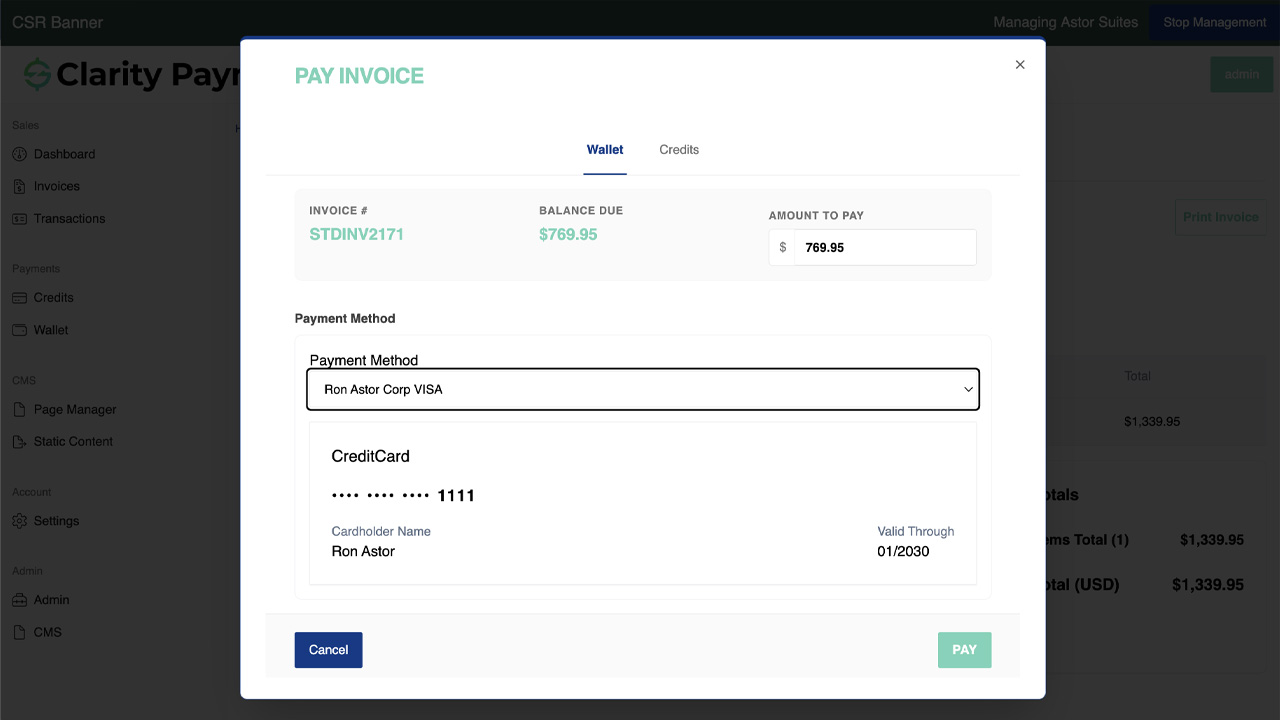
Gateway- and system-agnostic. Payment Hub integrates with NetSuite, Acumatica, Dynamics 365 Business Central, QuickBooks Enterprise, and works alongside Sage Intacct. Your PMS/EHR stays untouched. Your gateway stays your choice.
Common Healthcare Providers & Medical Practices Scenarios
Here are a few representative situations we see across healthcare providers and how Clarity Payment Hub addresses each:
Multi-location specialty practice on NetSuite
DME supplier billing facilities on Dynamics 365 BC
Dental group on QuickBooks Enterprise
Benefits for Healthcare Providers & Medical Practices Companies
Online self-service dramatically shortens patient-responsibility collection cycles.
Tokenization and elimination of phone-based card intake simplify compliance materially.
Patients pay on their own before or after the visit; front-desk staff stops taking card numbers over the phone.
Payments flow into NetSuite, Acumatica, Dynamics 365, or QuickBooks without manual keying.
Scheduled, tokenized payment plans run automatically — reducing defaults and administrative load.
Your patients pay the way they pay every other vendor — online, mobile, on their schedule.
Practice administrators and billing managers stop spending hours on patient collection calls. Controllers and CFOs see patient AR clear faster and PCI exposure shrink. Front-desk and back-office staff take fewer payment calls. Patients — the real customers — get a modern, familiar self-service payment experience that respects their time.
ERPs We Integrate With for Healthcare Providers & Medical Practices
Healthcare organizations run a wide range of financial platforms separate from their clinical systems. Payment Hub integrates with the most common ones through Clarity Connect. Sage Intacct is widely used in healthcare finance; it is not currently in our battlecard library, but Payment Hub integrates with Intacct through the same Clarity Connect patterns — contact us for specifics.
Popular with multi-location healthcare and specialty practices. Payment Hub adds patient and B2B payment flows.
→ AcumaticaCloud-native ERP flexible enough for specialty healthcare finance. Payment Hub extends any Acumatica tenant.
→ Dynamics 365 Business CentralMicrosoft's mid-market ERP. Payment Hub adds a patient and B2B portal on top.
→ QuickBooks EnterpriseThe go-to for small and mid-sized practices. Payment Hub turns QuickBooks into a payment platform.
Frequently Asked Questions
Is Payment Hub HIPAA-aware?
Payment Hub is designed to stay out of PHI scope. It handles payment data for balances and invoices; it does not process clinical information or detailed EOB data. Your PMS/EHR continues to be the system of record for PHI.
Does Payment Hub integrate with our PMS/EHR?
Payment Hub primarily integrates with your financial ERP, not your PMS/EHR. Many healthcare organizations push patient responsibility from the PMS into their ERP and have Payment Hub handle collection from there.
Can we reduce our PCI scope with Payment Hub?
Yes, meaningfully. Raw card data never touches your servers — it is tokenized and vaulted at the payment processor. Eliminating phone-based card intake reduces your exposure further.
Can we offer payment plans for patients?
Yes. You can schedule recurring payments against a tokenized payment method, and the portal surfaces plan status to the patient. Plan payments post automatically to your financial system.
How long does deployment take?
Most healthcare deployments go live within 48 hours of receiving ERP sandbox credentials.
Can we use our existing payment processor?
Yes. Payment Hub is gateway-agnostic. You keep your processor or switch to one better-suited for healthcare volume.
Related Industries
Ready to modernize patient and B2B payments for your healthcare organization?