



What Is the "Pay with Surcharge" Feature?
So what does "pay with surcharge" actually do? The Pay with Surcharge feature in Clarity Payment Hub integrates compliant credit card surcharges into your payment portal. When a customer selects a credit card as their payment method, the portal calculates a surcharge (typically 2-3% of the invoice amount) that covers the cost of credit card processing. The surcharge is displayed transparently before the customer authorizes the payment. Customers can see exactly what they will pay (original invoice + surcharge) or they can choose to avoid the surcharge by selecting an ACH bank transfer instead, which processes without an additional fee.
Unless an invoice is paid via paper check or direct ACH deposit, transaction charges end up the responsibility of the merchant. The critical insight here is that credit card processing costs money, often 2-4% of the transaction amount depending on the merchant category and card type. Traditionally, vendors have absorbed that cost themselves. But in a B2B context, there is no reason the vendor should bear this cost alone. It is the customer's choice to pay with a credit card instead of ACH or check, and that choice has a real cost. By offering surcharge options, you give customers the choice of how they want to pay while being transparent about the actual cost of their chosen payment method.
Why do we offer surcharge instead of just using convenience fees? We offer both. Some merchants prefer to implement a federally-compliant method, which is to surcharge. Clarity Payment Hub integrates surcharge functionality through compliant 3rd-party providers that handle state-by-state restrictions automatically. Some states, 5 at the time of this writing, restrict or prohibit surcharges. The system automatically suppresses surcharges for customers in those states, ensuring you stay compliant without manual intervention.
The Problem: Why Absorbing Credit Card Costs Erodes Margins
Credit card processing fees are a massive and often underappreciated cost for B2B companies. When a customer pays a $100,000 invoice with a corporate credit card, the processor takes 2-4% depending on the merchant category and card type. That is $2,000 to $4,000 in processing costs that comes directly out of your margin. Multiply that across thousands of customers and millions in invoice volume annually, and you are looking at hundreds of thousands of dollars in processing costs that many companies silently absorb.
The situation becomes even more stark in certain industries. Manufacturing, distribution, and wholesale companies often have high transaction volumes and large invoice amounts, which means massive aggregate processing costs. A company processing $100 million in annual invoices at 3% average processing costs is spending $3 million on credit card fees every year. That is capital that could be invested in operations, growth, or shareholder returns instead of being paid to payment processors.
Every credit card payment costs your company 2-4% of the transaction amount. With high invoice volumes, these costs compound to hundreds of thousands of dollars annually that come directly out of profit margins.
Vendors cannot raise prices across the board just to cover processing costs, as that harms competitiveness. Yet absorbing the costs hurts profitability. This creates a damaging false choice between margins and customer acquisition.
Customers often do not realize that their choice to pay with credit card instead of ACH has a real cost to the vendor. By not surfacing that cost, vendors miss an opportunity to educate customers and shift some transactions to lower-cost payment methods.
Companies that have implemented surcharges gain a competitive margin advantage over those that have not. Those without surcharges are essentially subsidizing the payment methods of their customers while competitors do not.
Surcharge regulations vary by state, and trying to implement surcharges manually while staying compliant is error-prone and risky. Many companies avoid surcharges entirely because the compliance burden feels too high.
How Clarity Payment Hub Enables Compliant Surcharge Pass-Through
Clarity Payment Hub solves the surcharge problem by integrating compliant surcharge functionality directly into the payment portal. When a customer selects a credit card as their payment method, the portal calculates the appropriate surcharge (typically 2-3% depending on your configuration) and displays it transparently before the customer authorizes the payment. The customer sees the original invoice amount, the calculated surcharge, and the total they will pay if they proceed. They then have the choice: pay with the surcharge, or select ACH (which has no surcharge) if they prefer to save the fee.
Behind the scenes, Clarity integrates with compliant 3rd-party surcharge providers that handle the regulatory complexity. The system automatically checks the customer's location and suppresses surcharges in states where they are restricted or prohibited. So a California customer never sees a surcharge (California does not allow them), but a Texas customer does. All of this happens automatically without any manual intervention or compliance risk on your end.
When the payment is submitted, the surcharge amount is calculated and posted separately to your ERP. This separate posting allows you to track surcharge revenue distinctly from invoice payments, measure the revenue impact, and understand your true margin improvement from the feature.
Customers see the surcharge amount calculated and displayed before they authorize. No surprises, no hidden fees. Complete transparency builds trust even when charging a fee.
The system automatically handles surcharge regulations across all states. Surcharges are shown where allowed and suppressed where restricted, with zero manual intervention or compliance risk.
Customers can pay with a surcharge via credit card, or avoid it by selecting ACH. This transparency and choice builds goodwill even though you are passing through costs.
Surcharges post to your ERP as separate line items, not mixed in with the invoice payment. This allows clear accounting, margin tracking, and reporting on surcharge revenue impact.
You set the surcharge percentage based on your actual processing costs and business needs. Different payment methods and card types can have different surcharge rates if desired.
Industry-leading compliance and support. Clarity Payment Hub partners with compliant 3rd-party surcharge service providers that stay on top of state and federal regulations. You do not have to worry about surcharge law changes, the partner handles updates automatically. Your compliance risk is minimized while you recover the margin impact of credit card processing costs.
The Missing LinkBetween Paymentsand Your ERP
Clarity Payment Hub closes that gap, connecting your orders, invoices, and payment channels into one flow.
Speak to a Platform ArchitectSee It in Action: Surcharge Payment Demo
Watch the Demo
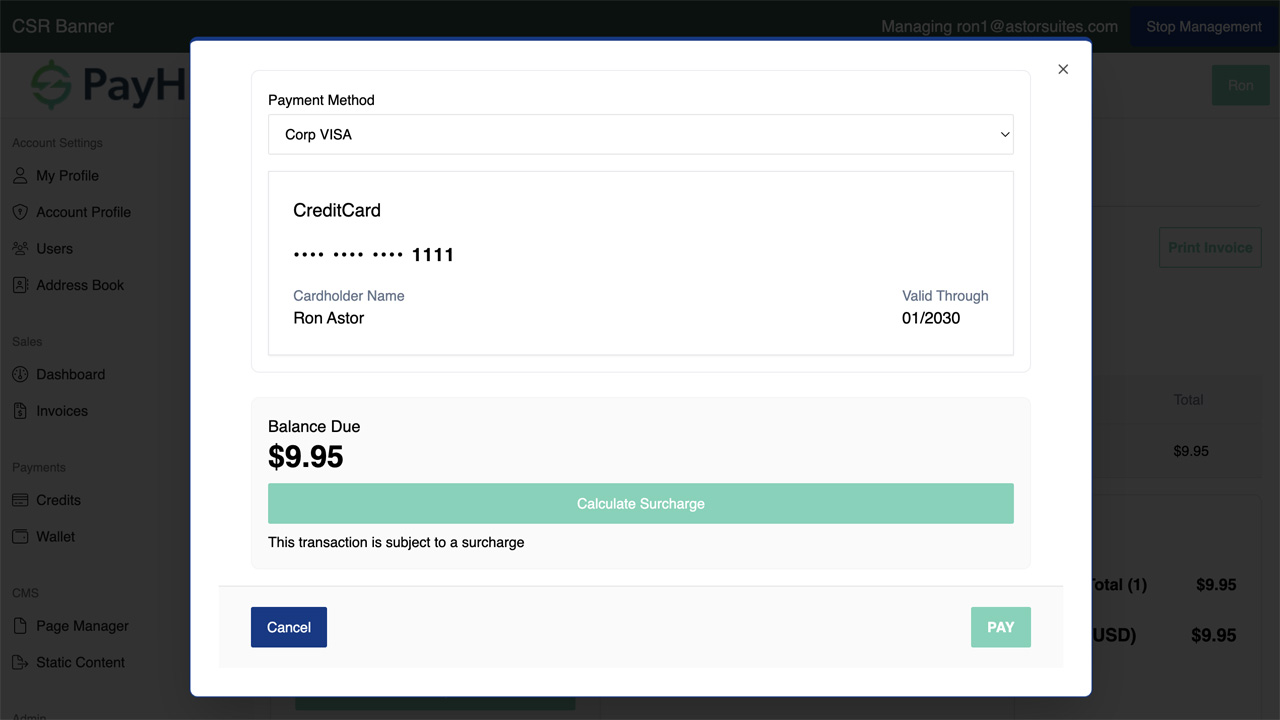
Portal Screenshot
Step-by-Step Walkthrough
Navigate to your Clarity Payment Portal and select the invoice you want to pay. View the invoice details including amount, due date, and payment history.
Select a payment method. If you choose Credit Card, the portal calculates the surcharge (if applicable in your state). If you choose ACH, there is no surcharge.
The portal shows a clear payment summary: original invoice amount, calculated surcharge, and total amount you will pay. This is displayed before you authorize, giving you full transparency.
You can proceed with the credit card payment including the surcharge, or you can go back and select ACH to avoid the surcharge. The choice is entirely yours.
Enter or select your credit card or ACH account. Your payment information is stored securely in a PCI DSS-compliant vault.
Click Pay to submit your payment. The transaction processes, and the surcharge (if included) is posted separately to your vendor's ERP as a distinct line item. You receive confirmation of the total paid, including any surcharge.
Benefits and Business Impact
Surcharge functionality creates significant financial and operational value. By transparently passing through actual processing costs, you recover margin, improve profitability, and educate customers about the true cost of payment methods. Here is what you gain:
By recovering 2-3% on credit card transactions, you directly improve your bottom line. On $100 million in annual invoice volume, that is $2-3 million in recovered margin that was previously lost to processing fees.
When customers see the surcharge, some will choose ACH to avoid the fee. ACH has lower processing costs, so every customer shift improves your economics. Even without shifting all customers, you recover costs on those who pay by credit card.
State-by-state surcharge regulation is handled automatically. You do not have to worry about which states allow surcharges, the system handles it. Your compliance risk is minimized.
Customers actually appreciate transparency about costs more than hidden charges. By showing the surcharge clearly and giving them a choice, you build trust even while charging a fee. This is less damaging to relationships than hidden costs.
Surcharges post as separate line items in your ERP, allowing you to track surcharge revenue distinctly. This visibility lets you measure the impact and optimize your pricing strategy.
Companies that implement surcharges gain a margin advantage over those that absorb processing costs. Over time, this compounds to a meaningful competitive advantage in profitability.
Surcharge functionality is one of the highest-impact financial features you can implement, especially if your company has high invoice volumes or large average transaction amounts. The margin recovery is immediate and measurable, and the regulatory complexity is handled automatically. This is a true competitive advantage that directly improves your bottom line.
Frequently Asked Questions
What is a surcharge and why am I seeing one?
A surcharge is a fee that covers credit card processing costs. Credit card transactions cost merchants 2-4% depending on the card type and merchant category. Instead of the vendor absorbing this cost, they pass it through to customers who choose to pay by credit card. This is compliant in most states. You can avoid the surcharge by paying with ACH bank transfer instead.
Is paying a surcharge mandatory?
No. The surcharge is optional and transparent. You see the surcharge amount before authorizing, and you have the choice to proceed with it or select a different payment method (like ACH) that does not include a surcharge.
Are surcharges legal?
Surcharges are legal in most states and are compliant under major payment networks. However, some states (like California, Colorado, Connecticut, and others) restrict or prohibit surcharges. Clarity Payment Hub integrates compliant 3rd-party surcharge services that automatically handle state-by-state restrictions, so you stay compliant without manual work.
How is the surcharge calculated?
The surcharge is calculated as a percentage of the invoice amount (typically 2-3% depending on your vendor's configuration). The exact percentage is determined by your vendor's surcharge service provider and is displayed transparently before you authorize payment.
Where does the surcharge go?
The surcharge is posted separately to your vendor's ERP as a distinct line item. This keeps accounting clean and allows your vendor to track surcharge revenue separately from invoice payments. The surcharge offsets the vendor's credit card processing costs.
Can I pay with ACH to avoid the surcharge?
Yes. ACH bank transfers do not include a surcharge. If you want to avoid the surcharge, select ACH as your payment method instead of a credit card. ACH is often slower (2-3 business days) but is surcharge-free.
Is this the same as dual pricing or convenience fees?
No. Dual pricing lets vendors charge different prices depending on payment method. Convenience fees are additional charges unrelated to processing costs. Clarity's surcharge integration is a transparent, compliant fee that covers actual credit card processing costs and is automatically adjusted per state restrictions. It is fundamentally different from both dual pricing and convenience fees.
Related Features
Faster AR. Fewer headaches.
See Clarity Payment Hub running inside your ERP, or spin up a free trial environment and click around on your own. Either way, you’ll see exactly how it handles your invoice mix, your gateway, and your Level II/III savings &mdash. Before you commit to anything.
Supported
Go-Live
Savings